Flanges: The Interface That Cannot Fail
Understanding Flange Types for Reliable Piping Connections
Cet article vous a plu ?
Partagez-le avec votre réseau
Cliquez pour copier le lien
Flanges: The Interface That Cannot Fail
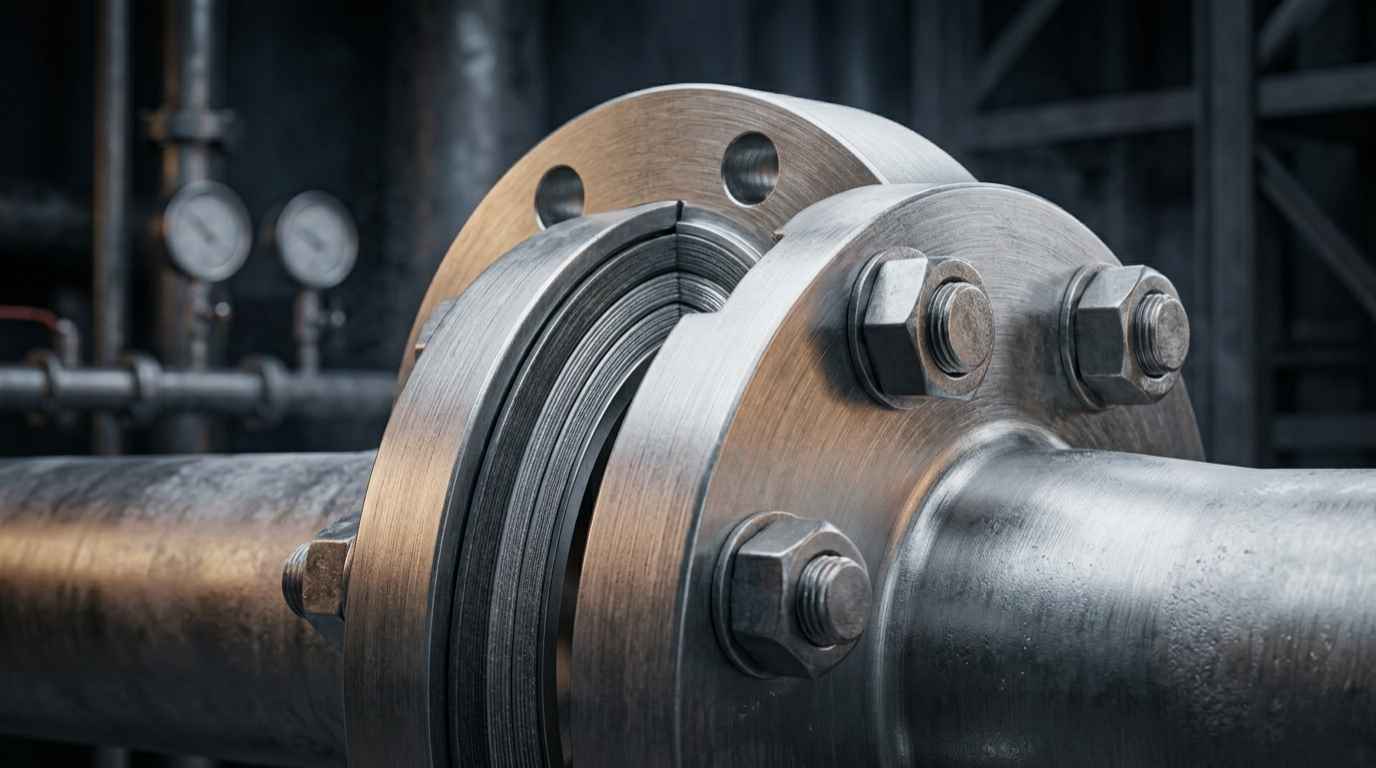
A flange joint is where two sections of a piping system meet, separate, and connect. In process industries, this interface is one of the most critical points in any system and one of the most common sources of failure when components are not properly specified or installed.
The choice of flange type directly affects the strength, reliability, and maintainability of the system. Selecting the right flange is essential to ensure long-term performance under pressure, temperature, and mechanical stress.
Flange Types
Weld Neck Flange (FLANGE WN)
The weld neck flange is the strongest and most reliable flange type in high-pressure, high-temperature, and cyclic service. Its long tapered hub transfers stress from the flange to the pipe gradually, reducing the concentration of mechanical stress at the joint.
It is the standard choice for:
- High-pressure process lines (Class 600 and above)
- Cryogenic and elevated temperature service
- Applications subject to bending loads or vibration
- Pipelines carrying hazardous or toxic media
The bore of the weld neck matches the internal diameter of the pipe, ensuring smooth, uninterrupted flow with no turbulence or erosion at the connection.
Slip-On Flange (FLANGE SO)
The slip-on flange slides over the pipe end and is welded both inside and outside. It is easier to align and install than a weld neck flange but offers lower fatigue resistance roughly two-thirds of the weld neck's strength under cyclic loading.
It is appropriate for lower-pressure utility and non-critical service lines where ease of installation is a practical consideration and system stresses are well within limits.
Socket Weld Flange (FLANGE SW)
The socket weld flange accepts the pipe into a recessed socket and is fillet-welded on the outside only. It is limited to smaller bore piping (typically DN 50 and below) and is common in high-pressure hydraulic and instrument lines where the small diameter would make butt welding impractical.
Note: the small internal crevice between pipe end and socket bottom can be a concern in corrosive or crevice-sensitive service this must be evaluated at specification stage.
Blind Flange (BLIND FLANGE)
The blind flange closes the end of a pipeline, vessel nozzle, or pressure vessel opening. Unlike a pipe cap, a blind flange is bolted rather than welded, making it removable essential for systems that require periodic inspection, cleaning, or future extension.
Blind flanges are also used as pressure test closures and as isolation blanks during commissioning and maintenance operations.
Getting the Joint Right
A flange joint involves the flange geometry, the facing type, the bolting, and the assembly procedure. Each variable affects the others. The most common cause of flange joint failure in service is not a material defect it is a mismatch between components, or incorrect bolt load during assembly.
TWH Steel supplies flanges with full material certification, dimensional verification, and marking to applicable standards including ASME B16.5, ASME B16.47, and EN 1092.