Butt Weld Fittings: Choosing the Right Elbow, Tee & Reducer
A Technical Guide to Pipe Fittings for High-Pressure Industrial Systems
Cet article vous a plu ?
Partagez-le avec votre réseau
Cliquez pour copier le lien
Butt Weld Fittings: Choosing the Right Elbow, Tee & Reducer
In any industrial piping system whether in oil & gas, petrochemical, power generation or shipbuilding the choice of butt weld fittings is a decision that directly impacts flow efficiency, pressure integrity, and long-term reliability.
At TWH Steel, we supply the full range of butt weld fittings to exacting standards, and the questions we hear most often from engineers and procurement teams come down to one thing: which fitting, and why.
This article breaks down the most commonly specified components and the engineering logic behind each choice.
Elbows: Long Radius vs Short Radius
Elbows redirect flow. The geometry you choose determines how much turbulence, pressure drop, and mechanical stress your system absorbs at every change of direction.
90° Elbow Long Radius (LR)
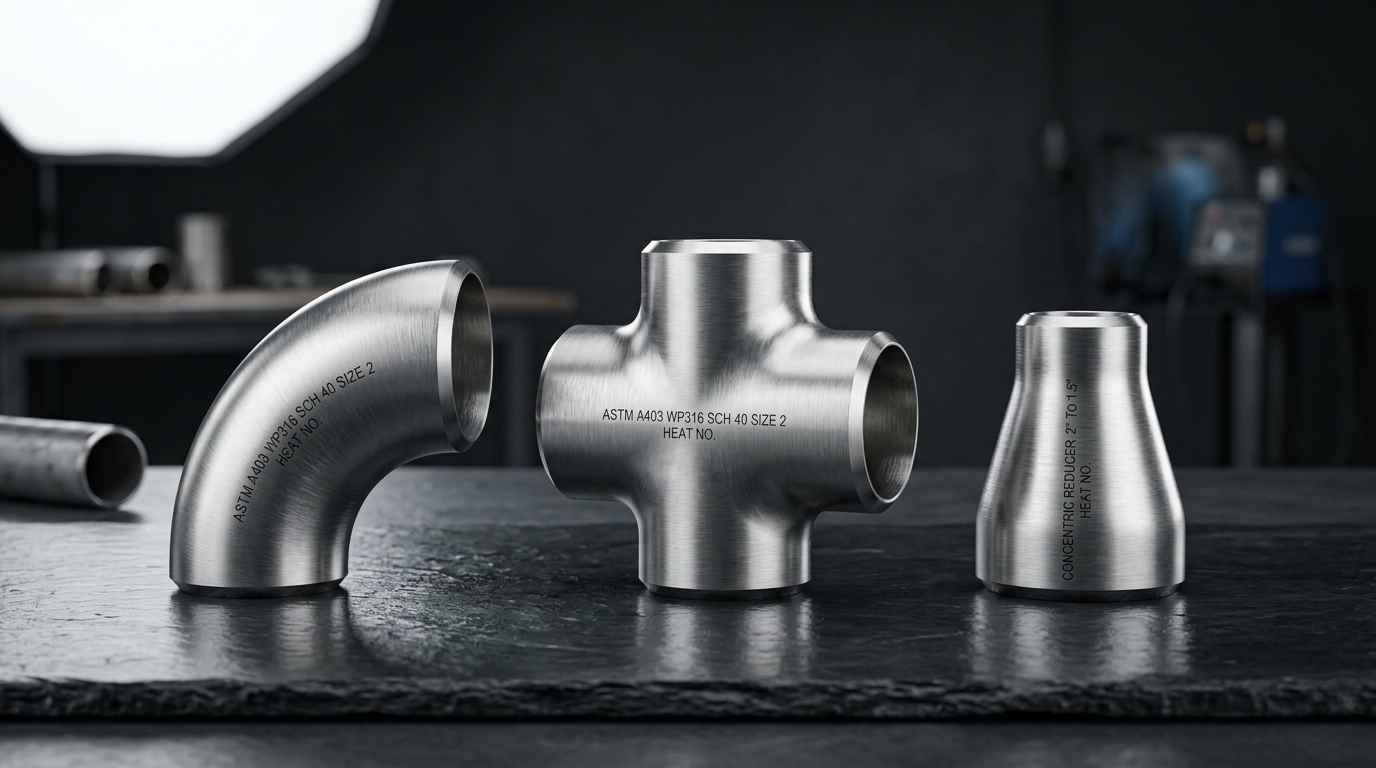
The 90° LR elbow is the default choice for most process piping. With a centerline radius of 1.5× the nominal pipe diameter, it allows flow to change direction gradually, minimising turbulence and erosion.
It is the preferred option whenever space permits particularly in systems carrying abrasive media, high-velocity fluids, or where long-term fatigue resistance is critical.
90° Elbow Short Radius (SR)
The 90° SR elbow uses a tighter radius of 1.0× the nominal diameter, making it the choice when installation space is constrained. The trade-off is a higher pressure drop and greater turbulence, so its use is typically limited to low-velocity or utility systems where spatial constraints outweigh hydraulic efficiency.
45° Elbows LR and SR
The 45° elbow achieves a shallower direction change, producing significantly less flow resistance than a 90°. Both LR and SR variants are available. In systems where routing geometry allows it, combining two 45° LR elbows is often preferable to a single 90° for critical service lines.
Tees: Equal and Reducing
A tee creates a branch connection in the pipeline. The choice between equal and reducing depends on flow distribution requirements.
Equal Tee
All three openings share the same nominal bore. Used when the branch flow requirement matches the main line common in distribution headers, utility systems, and symmetrical process loops.
Reducing Tee
The branch outlet is a smaller bore than the run pipe. This is the correct choice when the branch serves a secondary or lower-flow circuit, avoiding the need for an additional reducer downstream of the connection.
In both cases, butt weld tees offer superior strength and leak resistance compared to threaded or socket weld alternatives, making them the standard for pressure-critical applications.
Reducers: Concentric vs Eccentric
Reducers transition between two pipe sizes. The choice of geometry here is not aesthetic it has direct operational consequences.
Concentric Reducer (CON RED)
Both ends share the same centreline. Used in vertical piping runs and in gas systems where a consistent centreline alignment is required. In horizontal liquid lines, however, a concentric reducer can trap gas at the top of the pipe.
Eccentric Reducer (ECC RED)
One side of the reducer is flat (either flat-on-top or flat-on-bottom depending on application). This geometry is the standard choice for horizontal liquid lines as it prevents air or gas pockets from accumulating, ensuring consistent flow and accurate instrumentation readings.
A common specification rule: flat-on-top (FOT) at pump suction lines to avoid cavitation; flat-on-bottom (FOB) at drain points.
Cap
The pipe cap closes the end of a pipeline or branch. Butt weld caps provide a permanent, pressure-rated closure and are standard for end-of-line terminations in high-pressure systems. They are significantly more reliable than threaded caps in applications subject to vibration, thermal cycling, or pressure fluctuation.
Material and Standards
All butt weld fittings at TWH Steel are available across a wide range of materials carbon steel, stainless steel, alloy steel, and exotic grades and manufactured to the primary international standards:
- ASME B16.9 Factory-made wrought fittings
- ASME B16.28 Short radius elbows and returns
- MSS SP-75 High-strength wrought fittings
- EN 10253 European standard for butt weld fittings
Wall thickness schedules from SCH 10 through SCH XXS are held in stock or available on short lead times.
The Right Fitting for the Right System
Selecting butt weld fittings is an engineering decision, not a purchasing one. The geometry, material grade, pressure class, and end preparation all interact and an incorrect choice at specification stage creates problems that are expensive to correct once a system is built.
TWH Steel's technical team works directly with engineers and procurement teams to ensure the right components reach site on time, with full documentation and traceability.
For technical queries, material certifications, or stock availability on any butt weld fitting, contact the TWH Steel team directly.